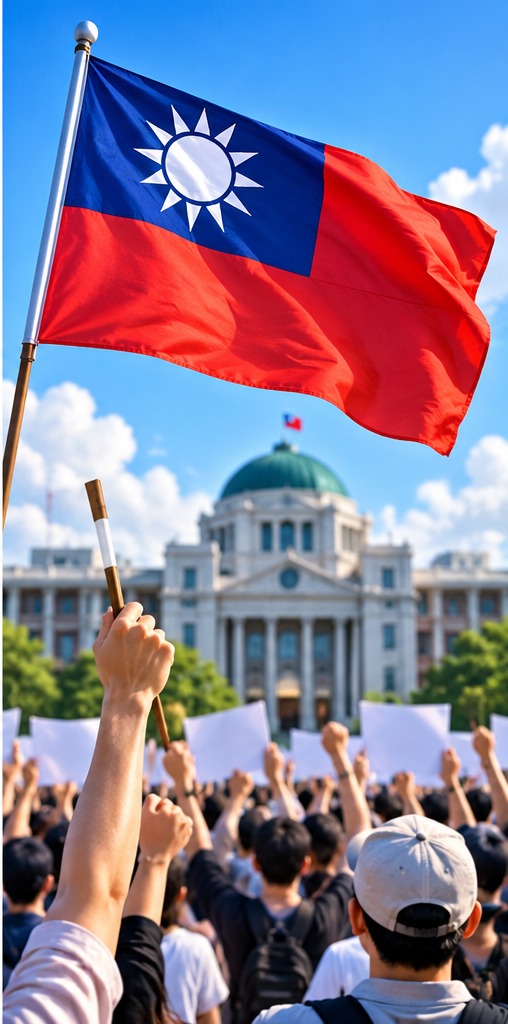
The Great Recall—Defending Taiwan's Sovereignty and Independence
In 2025, Taiwan witnessed an unprecedented mass recall movement. More than a million petition signatures were gathered nationwide. Citizens spontaneously sought to check legislators from the Kuomintang (KMT) and Taiwan People's Party (TPP), whose legislative majority had advanced highly controversial bills. Following the recall of Kaohsiung mayor Han Kuo-yu, this was another powerful expression of civic resistance to perceived abuses of party power.
The reasons behind the great recall movement can be summarized as follows:
1. Betraying the nation and the party. Soon after taking office, KMT legislator Fu Kun-chi led a delegation including Wang Hung-wei—17 legislators in all—to Beijing on April 26, 2024, where, in the author's view, they took direction from Wang Huning, a senior Chinese Communist Party (CCP) official responsible for united-front affairs. This represented a betrayal of the KMT's original anti-communist mission and an alliance with the CCP.
2. Cutting defense spending. The KMT and TPP jointly reduced defense budgets, threatening Taiwan's overall defensive capabilities and sending international allies the wrong signal about Taiwan's determination to defend itself. In the author's judgment, these legislators have become puppets of the CCP and lost their legitimacy as representatives of Taiwan's people.
3. Forcing through legislation expanding legislative power. The parties sharply cut the fiscal year 2025 central budget, disregarded objections and legislative procedure, closed doors and ended sessions, adopted motions with one-minute decisions, deprived other parties of opportunities to speak, and convened surprise meetings. The legislature became a tool of the KMT–TPP voting majority. Legislators including Fu Kun-chi and Wang Hung-wei pushed through a NT$370 billion amendment to the fiscal allocation law without clearly specifying how the funds would be used, while cutting budgets for policing, national health insurance, firefighting and other basic services. The author argues these measures would weaken public safety and medical resources. Changes to the election and recall law also raised recall thresholds, undermining citizens' constitutionally protected oversight of public power.
4. Lies and sophistry. Criminal wrongdoing is recast as political persecution. Fu Kun-chi, who has faced convictions in securities and tax-related cases and controversy over a sham divorce, returned to the legislature after serving his sentence. When investigators searched in connection with an election-related case, he described the investigation as political persecution, seeking, in the author's view, to turn criminal allegations into partisan disputes, much as Ko Wen-je has done. The author criticizes his 'Hualien dynasty' style as placing personal interests above the nation. KMT chairman Eric Chu's comparison involving Nazism, despite the KMT holding more legislative seats than the DPP, also drew public criticism from the German Institute Taipei, which expressed deep disappointment and concern.
5. Betraying Taiwan's sovereignty. The author accuses politicians of colluding with the CCP's political infiltration of Taiwan through organized crime, media, retired military and police personnel, schools, neighborhood chiefs and religious temples. He cites more than 65 cases involving prosecutions for alleged espionage-related work as evidence of the depth of the threat to democracy.
6. Obstructing stronger anti-infiltration laws. Opponents portray such laws as infringements on civil liberties and resist tougher penalties for receiving CCP funding in exchange for intelligence. At the same time, the author criticizes proposals that would ease the entry of Chinese funds, which he fears could finance theft of advanced technology and political infiltration. He argues that Chinese capital can fuel property-price surges and money laundering abroad, and that the KMT–TPP legislative majority has pursued electoral and cross-strait policy changes that weaken Taiwan's international bargaining position and betray its sovereignty.
7. Holding voters hostage. The proposed NT$10,000 payment per person became a political bargaining chip. At an anti-recall rally, Han Kuo-yu warned that the payment would be 'confiscated' if recalls succeeded. The author regards this as an attempt to manipulate voters through financial incentives and an affront to democratic principles.
The author criticizes the DPP government for tolerating suspected collaboration with hostile forces and failing to apply a zero-tolerance approach to threats against sovereignty. He argues that the CCP's long-running infiltration and influence operations, together with politicians and business groups seeking economic advantage, seriously erode democracy and national security. Failure to respond, he warns, would undermine trust in both law and government.
Ensuring National Security and Independence
1. Immediately establish a special national-security investigation unit, bringing together the Ministry of Justice, Ministry of the Interior and National Security Bureau to investigate and prosecute suspected collaboration with the hostile Chinese communist regime, accelerate proceedings, conduct public trials and seek severe sentences.
2. Freeze assets. Through cooperation among the Financial Supervisory Commission, Ministry of Justice and district prosecutors, trace suspicious financial flows and, where links to the CCP are found, promptly seek court orders to freeze assets and investigate.
3. Strengthen anti-infiltration education and whistleblower rewards. Ministries and local governments should regularly provide education and reward those who supply relevant information.
The DPP government must put sovereignty first and show firm resolve. The author urges swift investigation and adjudication of collusion or profiteering involving the CCP, with severe penalties to deter efforts to overturn Taiwan's sovereignty and democracy.
The author alleges that, to obstruct the recall movement, KMT actors forged recall petitions, misused voters' personal information and cooperated covertly with local administrative offices to interfere with petition efforts. He sees citizen-led recalls as democracy's strongest immune system and argues that voting is essential to restore a legislature that represents the people rather than party interests.
He calls on voters to set aside small personal favors and material inducements, act on fundamental principles, participate actively in recalls and vote to defend Taiwan's sovereignty, democracy, freedom and dignity.
The author praises businessman Robert Tsao for committing substantial resources and connections to Taiwan's sovereignty and independence, and for demonstrating pragmatic, innovative and principled leadership.
← Back to articles