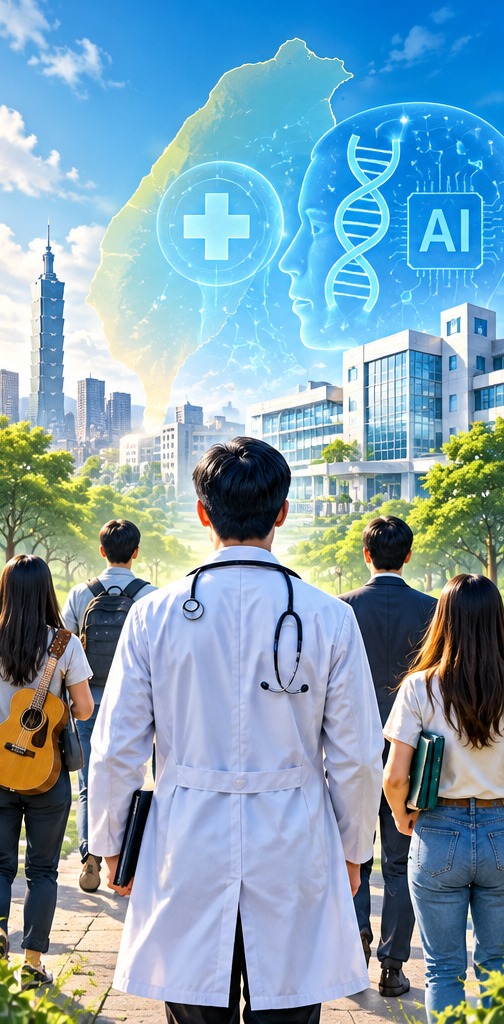
The Path to a Strong Nation
After graduating from university, people tend to be more mature. They are better able to grasp the essence of people, events, and things, to think and analyze deeply, and to appreciate different perspectives.
In the United States, medical and law schools admit students after they have completed four years of undergraduate education, and graduates of any major may apply. Medical school applicants must take the MCAT, a comprehensive examination that assesses their scientific foundations, reasoning, learning, and ability to integrate knowledge rather than simply testing clinical medicine. As a result, fewer than half of medical school entrants majored in biology; the others come from fields such as languages, business, economics, music, and information and communications technology.
The quality of healthcare depends on more than medical knowledge and technical skills. Attitude, communication, compassion, respect for life, responsibility, and conviction are equally important humanistic qualities. They give professional roles their deeper meaning. Physicians, judges, and lawyers work in professions that are profoundly human in nature.
In Taiwan, shortages of medical and nursing personnel and excessive litigation have left doctors and judges facing too many patients or cases. They cannot give each patient or case the careful attention it deserves, nor can they readily learn and grow through their work. This has contributed to the phenomenon of so-called 'dinosaur judges' and to the public's poor assessment of the legal profession.
In recent years, 'smart healthcare' has become a major topic worldwide. By combining AI, big data, 3D technologies, virtual reality, and 5G with the vast information in Taiwan's unique National Health Insurance database—whose use should, in my view, be enabled through timely regulatory reform—Taiwan could develop a second 'sacred mountain protecting the nation,' perhaps one even more significant than the first. Achieving this would require close cooperation between the hardware and software industries. Taiwan is already far behind the United States in this area.
In the years ahead, as smart healthcare becomes widespread, the relative importance of memorized medical knowledge will diminish. AI can store immense quantities of existing medical knowledge, learn, reorganize information, interpret images, and identify subtle details that humans cannot detect. Knowledge is a tool for improving human life; we need not regard it as something sacred that can reveal the ultimate truth of the world. Passion and a warm personality will remain indispensable.
Taiwan must move away from three high-school years dominated by rote memorization, repeated drills—including mathematical problem-solving—and after-school cram classes that turn students into test-taking machines. Some even retake entrance examinations repeatedly in pursuit of admission to National Taiwan University College of Medicine, as Ko Wen-je did, wasting time and resources. The author argues that attempts to prove one's superior intelligence by belittling others reveal a lack of cultivation in the less rational dimensions of the human spirit. In fact, within an organization governed by standard procedures and a defined scope of training, anyone of average aptitude who is willing to work hard can become a physician.
Human knowledge and rational science resemble blind people feeling an elephant: there is no complete and final right or wrong. Knowledge is a product of its time, constantly discarded and replaced. Only the humanistic spirit transcends time.
It is painful to see fifteen-year-old students just entering high school burdened with mistaken values because of parental expectations, the income associated with medicine, or its perceived social status. Please lift that cross from their shoulders. The age of ignorance is past. The world is flat and knowledge is readily available. If civil-service appointments at every level continue to reward those who merely memorize a few books, pass an examination, and expect lifelong security, Taiwan will be in danger.
Fortunately, Taiwan's democratization and the vigorous development of large, medium-sized, and small businesses have nurtured talent across many industries. Although many Taiwanese privately hold a low opinion of much of the civil service, they have the tolerance to 'see through things without saying so.'
I hope the government will address two of Taiwan's most serious longstanding problems: shortages of medical and nursing personnel and the poor quality of the judicial system. It must understand that the essence of power is responsibility, and that recognizing problems without trying to solve them is negligence. I hope the lingering scenes of regret that so often appear hazily in my mind will fade like an unfinished dream, leaving nothing unresolved.
← Back to Articles