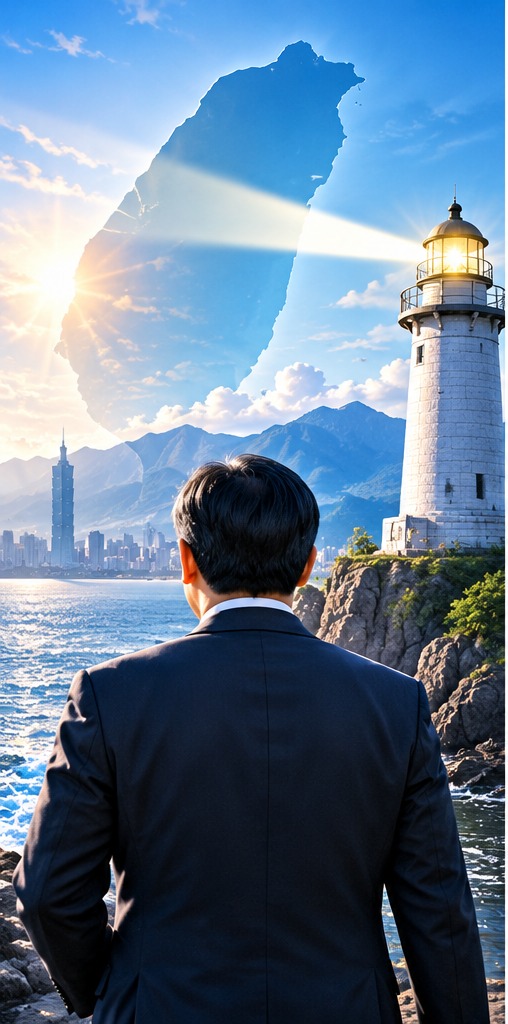
Leadership with Resolve—An Open Letter to President Lai
A national leader's place in history is often measured not by the structures built, but by the irreplaceable values preserved in times of danger.
Bridges, roads, industrial development, investment, and social welfare can enrich an era and leave celebrated achievements. Yet if a nation's soul—freedom, democracy, and the right to self-determination—quietly disappears, those achievements weigh little on history's scales.
Buildings can be rebuilt, economies can recover, and industries can transform. But once the light of liberty is forcibly extinguished, rekindling it may cost generations and countless lives. This is no empty alarm: it defines a leader's most fundamental responsibility.
The president's highest mission is not to please the public in daily polls or calculate electoral gains and losses. Your central duty is to ensure that, when you return power to the people, Taiwan remains a free country with its soul intact, where 23 million people can speak, choose, criticize, and determine their own destiny.
A Vigil That Cannot Afford to Fail
We stand at a historical threshold that concerns our very survival.
The Chinese Communist Party's totalitarian system is more than a conventional military threat: it embodies an authoritarian logic capable of expansion and erosion. Its dangers, in my view, extend far beyond the Taiwan Strait to democracies worldwide.
Even the United States, one of democracy's strongest bastions, faces what I regard as a silent struggle:
From extraterritorial coercion and transnational repression of dissidents to the flow of narcotics and fentanyl, which I see as threats to other societies and public health.
From the use of well-funded academic exchanges to penetrate American universities, appropriate advanced research, and undermine academic freedom.
To extensive political and commercial networks that can covertly influence government decisions and legislation in democratic countries.
When even a superpower's defenses appear vulnerable to such subtle erosion, Taiwan's danger becomes especially acute. A regime capable of weakening a democracy from within may apply still greater pressure and more precise methods against its nearest target.
The most effective infiltration seldom announces itself. It may wear the guise of cultural exchange, offer the promise of commercial benefit, or proclaim peaceful coexistence. Its danger lies in seeming harmless at first. Totalitarianism's greatest victory comes not when it defeats democracy outright, but when democratic societies lose the ability to recognize it.
I therefore hope you will use clear philosophical judgment and sober reasoning to place national security at the highest level of governance. This must be more than a moral appeal: it must become an institutional defense.
State secrets, critical infrastructure, and essential defense technologies—including semiconductors, artificial intelligence, biotechnology, cybersecurity, and energy—require far stronger safeguards.
There must be no privilege in matters of national security. Whether a former senior official, a business magnate, or a respected scholar, anyone who becomes an instrument of a hostile foreign force through illegal funding, theft of secrets, clandestine intelligence networks, or interference in democratic processes must face the law. The law's dignity lies not in punishing the weak, but in its ability to restrain the powerful.
A Precious Way of Life
People can criticize those in power without fearing a knock at the door in the middle of the night.
Journalists can investigate governments and corporations without political intimidation.
The judiciary can remain independent, its scales unmoved by political will.
People with opposing beliefs can still sit together, share a drink, and reason with one another.
What we must protect is not merely this island's borders, but the precious way of life within them. These ordinary freedoms are among East Asia's most fragile and brilliant achievements of civilization.
To safeguard them, I propose institutionalized national-security reports: not daily political sparring, but regular explanations to citizens, supported by rational evidence and clear reasoning.
National resilience depends not only on military strength, but on citizens' critical judgment, independent media, responsible businesses, and a society that understands what it is defending when faced with fear or temptation.
Taiwan's achievements were built over decades by small and medium-sized businesses, engineers, workers, and ordinary families through diligence, skill, and resilience. Democracy gives society the capacity to repair itself, make mistakes, and correct them.
But national security is different. Some compromises and mistakes cannot be reversed. A failed policy can be changed and an election can be contested again four years later; once sovereignty and democratic institutions are lost, however, citizens may lose the ballot as a means of correcting history.
History offers many examples of nations undone not by blindness but by wishful thinking. They heard warnings yet deferred responsibility, until everyone stood at the cliff's edge waiting for someone else to act.
President Lai, I hope your term will become Taiwan's strongest breakwater, and that hesitation will not cause you to miss the moment to defend it.
History's Question
In observing your administration, we recognize its caution. Such restraint may reflect democratic self-discipline or a desire to avoid social division. In peaceful times these are admirable qualities.
Yet we face a crisis that threatens survival and may be irreversible. In such circumstances, excessive caution can cease to be a virtue and become a grave national-security risk.
National security demands decisions. Repeatedly waiting for a supposedly better moment can itself be dangerous. We do not seek a president driven by emotion or blind toughness, but one with firm resolve, sound judgment, and the courage to act decisively within the law.
Resolve is not the opposite of democracy. In a mature state governed by law, executive decisiveness is legitimate when subject to judicial oversight. Society should fear not a president who acts firmly within legal limits, but a government paralyzed by political controversy even as danger approaches.
President Lai, democracy needs warmth, but national security also needs strength. Leadership requires humility, yet in crisis it also requires decisions and the courage to bear their consequences. History does not demand that leaders foresee everything; it asks whether they acted when the danger had become clear.
Taiwan now needs genuine resolve—not to manufacture enemies at home, but to draw an unmistakable boundary against authoritarian threats abroad. We need a president with greater decisiveness, effectiveness, and willingness to shoulder the nation's future. Put national security at the highest level, because protecting Taiwan matters more than any administrative achievement.
Political achievements belong to one presidency; freedom and democracy must belong to generations.
← Back to articles